Anaventure

 Come start the“Annaventure” with me!

Category: Community and Collective Experience

  • Standing with Cantonese as a Mainlander

    I have long struggled with my beloved and hated Chinese identity. I often say, “我恨东亚恨入骨血,我爱东亚又如心脏”—I hate East Asia with every fiber of my being, yet I love it as dearly as my own heart. Living within Chinese society for so long has left me with a deeply internalized sense of self-condemnation that surfaces in almost every intercultural experience I have.

    When I spend too much time within my own identity community, a voice inside me whispers: Then why study abroad? You’re not even engaging with local people—shame on you. Yet when I engage deeply with the local community and am seen doing so by people from my own, another anxiety takes over: Will they think I’m whitewashed? Will they think I’m selectively abandoning my identity? No matter which direction I turn, something always feels misaligned, as if I am failing an unspoken test.

    This semester, however, I have begun to feel a sense of relief. I found myself standing with my community in a different way—not through retreat or assimilation, but through responsibility. I founded the Cantonese table and helped establish the first credit-bearing Cantonese class. In doing so, I listened closely to my community, acknowledged the collective identity we share, and recognized the struggles that bind us together. More importantly, I chose to act.

    These actions did not pull me away from the local community; instead, they allowed me to present my own community to it—openly and proudly. I am no longer torn between belonging and engagement. I have learned that standing with my community does not mean closing myself off from others, and engaging across cultures does not require erasing where I come from. In this space of action, I have found a way to hold my contradictions without shame. My identity no longer feels like something I must justify; it has become something I can inhabit with intention and care.

  • West African Dance: Community, Body, and Dancing Beyond Mirrors

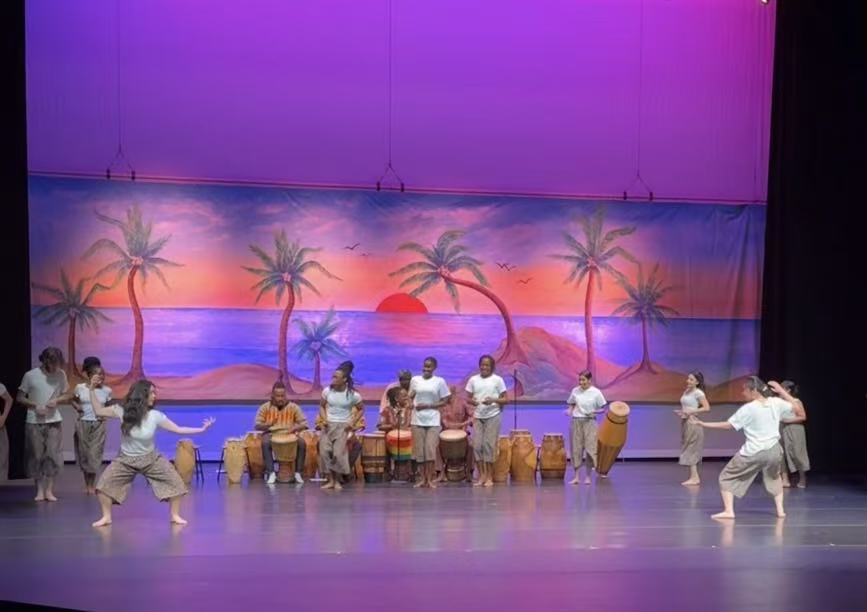
    “In this class, we’re not working toward perfection. Everyone’s body has its own way of doing the movements, and we’re all beautiful when we’re embodying the joy of our ancestors,” Prof. Iddrisu Saaka said to us. Hearing this shook me to the deepest gut of mine.

    Taking West African dance was the first time I learned that dance can be something experienced as a community, rather than something placed on a pedestal and only to be admired from a distance. It showed me that in that culture, dance is for everyone, regardless of body type.

    In my country, dance is rarely taught or understood as something that can be performed by someone who weighs more than 50 kilograms or who has not received formal training. It is not for everyone. And I’m never considered one of those “qualified” to dance. Dance belongs on a stage: the audience’s role is to admire, and the dancers’ role is to perform. This class was my first exposure to a form of dance that is deeply historical, cultural, and communally grounded.

    At the beginning, I was very nervous about not copying the movements perfectly or not catching the rhythm exactly and especially doing dance without a mirror. But very quickly, this choice revealed something important about myself. When I dance in front of a mirror, I judge myself constantly—my posture, my lines, whether I am “doing it right”—and that constant self-evaluation pulls me away from feeling the spirit and embodiment of dance.

    Learning without a mirror forced me to pay attention to the communal spirit and context behind each movement in the live music, in moving alongside my peers, in the movements, and in being present in my own body. It also made me realize that most communal dances weren’t created with the mirror or with the purpose of being staged… It’s a nature conversation between the people, the music, the land, the history, the body, the mind, and everything around.